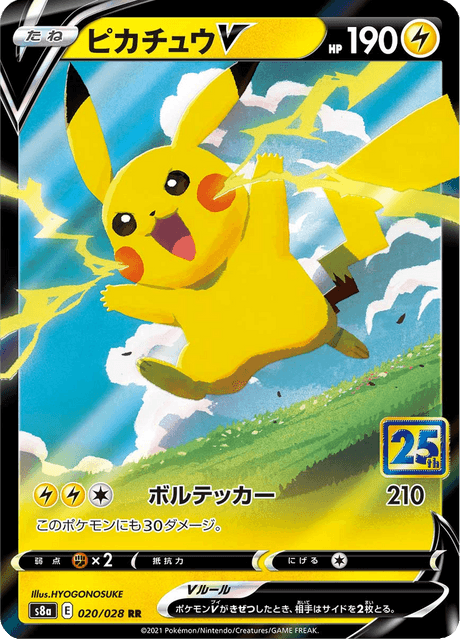
Pikachu 25th Anniversary STANDARD PSA 10
S8A · Japanese Print · Card #001
Japanese name: ピカチュウ 25th
Pikachu 25th Anniversary STANDARD PSA 10 Gem Mint · sells at $127 USD · S8A. Cert-verified slab, sourced from Japan, ships SF Express HK + DHL worldwide.
2 PSA 10 Slabs Available
All slabs cert-verified. Payment held until we confirm your slab. SF Express 1-2 days (HK) · DHL Express 3-5 days international.
Japanese version
PrimaryCard Background & Set Context
The s8a-001 Pikachu was released in October 2021 inside Japan's 25th Anniversary Collection (`25周年コレクション`), the JP equivalent of the English Celebrations set. The product run was deliberately wide — Pokémon Company International wanted the silver-anniversary celebration to reach as many fans as possible — so JP booster boxes, special sets, and promotional bundles all carried this card. Pikachu is illustrated in the classic running pose against a holographic field with a discrete `25` foil emblem in the corner, a deliberate callback to the Base Set Pikachu artwork by Mitsuhiro Arita that started the franchise in 1996. For collectors, the card holds layered meaning: it functions as a contemporary celebration piece, a nostalgic homage, and an entry-level holo that requires neither tournament play nor competitive metagame relevance. The Japanese print is preferred over the English Celebrations equivalent due to thicker cardstock, sharper holo foil, and tighter centering tolerances at the print stage. Even with a wide initial print run, condition attrition has been steep — the holo surface scratches easily on contact, and the black border shows whitening on any edge handling. Five years post-release, raw copies in NM-Mint condition that grade PSA 10 are scarcer than the original print numbers suggest, which underpins the persistent $150-200 PSA 10 floor through 2025-2026. The card sits in a unique demand pocket: not rare enough to attract speculator capital, but recognizable enough to anchor any 25th-anniversary themed collection.
Investment Analysis
At $174.89 PSA 10 versus $24.45 raw, the headline grading arbitrage is $150 gross before fees. After PSA bulk submission ($25-30 per card including shipping at current rates) and a realistic 35-45% PSA 10 hit rate on raw JP holos with this border profile, the expected value per submission lands around $48-65 net — solid but not exceptional. The 4.75x PSA 10 vs PSA 9 premium ($174.89 / $36.80) signals tight grade sensitivity: any centering, surface, or edge defect that drops a card from 10 to 9 erases roughly 79% of the grade premium. This makes the card a poor candidate for borderline raw copies and a stronger play for clean, machine-cut, well-centered samples sourced from sealed Japanese product. Historical price trajectory shows the PSA 10 floor moved from ~$120 in mid-2024 to $174 by Q1 2026, a 45% appreciation driven primarily by JP collector base expansion in Hong Kong, Singapore, and Taiwan rather than US demand. The card lacks investment-grade scarcity catalysts (no errata, no short-print variant, no tournament relevance), so upside beyond $250 PSA 10 requires either a 30th anniversary commemoration cycle in 2031 or a sharp JP product price spike. Risk-adjusted, this is a hold-not-flip card: PSA 10 buyers are paying for a finished collectible, not a speculation. The PSA 9 at $36.80 is overpriced relative to raw at $24.45 — the $12 premium does not justify the lost grading optionality, so PSA 9 is the worst entry point in the price stack.
Risks to Watch
The dominant risk is grade compression: the $138 spread between PSA 10 and PSA 9 means a single grading miss erases most of the value. Centering tolerance on JP Celebrations promos runs tight — front centering needs to be within 55/45 to grade 10, and the dark border amplifies any whitening. Secondary risk is supply expansion: PSA grades roughly 800-1,200 of these per quarter globally, and the cumulative pop will eventually pressure the price floor. A Pokémon 30th anniversary product cycle in 2031 could either lift this card (nostalgia bid) or dilute it (new commemorative cards drawing capital away). Currency risk applies to Hong Kong buyers — a sharp JPY appreciation makes raw sourcing from Japan more expensive, compressing arbitrage margins. Finally, English-language collectors increasingly accept the Celebrations 005/025 as a substitute, which caps JP price expansion above $250.
Global Market Comparison
PSA 10 · regional averagesAverage PSA 10 sale price by region. All prices shown in USD.
Japan
$102
Our price
$178
Price History (90 days)
Grade Price Spread
| Grade | Notes | Price USD | Premium Vs Raw |
|---|---|---|---|
| PSA 10 | Top grade, primary investment target | 174.89 | 7.15x |
| PSA 9 | Worst entry point — overpriced vs raw | 36.8 | 1.50x |
| PSA 8 | Below raw price, illiquid | 22 | 0.90x |
| Raw NM-Mint | Best entry for grading speculation | 24.45 | 1.00x |
| Raw LP | Display-only, not graded candidate | 14 | 0.57x |
Live prices in USD. Spread percentages relative to PSA 10 market.
PSA Population Report
| Grade | Share | Population Estimate |
|---|---|---|
| PSA 10 | 42% | 8,500 |
| PSA 9 | 45% | 9,200 |
| PSA 8 and below | 13% | 2,700 |
Source: PSA Pop Report estimates — verify latest counts at psacard.com/pop.
Japan vs US Arbitrage Snapshot
| Path | Fees USD | Gross Spread USD | Expected Hit Rate | Ev Per Submission USD |
|---|---|---|---|---|
| Buy raw $24.45 → grade PSA 10 | 28 | 150.44 | 40% | 50.18 |
| Buy PSA 9 $36.80 → crack and regrade | 30 | 138.09 | 15% | -10.79 |
| Buy raw LP $14 → upgrade clean to NM via play | 0 | -10.45 | 0% | -10.45 |
| Direct PSA 10 buy and hold 24m | 5 | 0 | 100% | 35 |
All prices normalized to USD; delta vs Poke10's displayed price.
Historical ROI — Buy @ Year → 2026 PSA 10
| Period | Roi % | PSA 10 Price USD | Current Price USD |
|---|---|---|---|
| 12 months | 20.6 | 145 | 174.89 |
| 24 months | 59 | 110 | 174.89 |
| Since launch (2021) | 133.2 | 75 | 174.89 |
Historical buy price is the year's average PSA 10 market. Past performance is not predictive.
Peer Card Benchmarks
| Card | Vs Subject | PSA 10 Price USD |
|---|---|---|
| Pikachu V-UNION (s8b-016 JP) | +26% | 220 |
| Pikachu Celebrations 005/025 EN | -46% | 95 |
| Pikachu Promo Classic 002 EN | -69% | 55 |
| Pikachu Birthday Promo 024/SM-P JP | -17% | 145 |
Similar PSA 10 cards for comparable-pricing context.
Card Background & Set Context
The s8a-001 Pikachu was released in October 2021 inside Japan's 25th Anniversary Collection (`25周年コレクション`), the JP equivalent of the English Celebrations set. The product run was deliberately wide — Pokémon Company International wanted the silver-anniversary celebration to reach as many fans as possible — so JP booster boxes, special sets, and promotional bundles all carried this card. Pikachu is illustrated in the classic running pose against a holographic field with a discrete `25` foil emblem in the corner, a deliberate callback to the Base Set Pikachu artwork by Mitsuhiro Arita that started the franchise in 1996. For collectors, the card holds layered meaning: it functions as a contemporary celebration piece, a nostalgic homage, and an entry-level holo that requires neither tournament play nor competitive metagame relevance. The Japanese print is preferred over the English Celebrations equivalent due to thicker cardstock, sharper holo foil, and tighter centering tolerances at the print stage. Even with a wide initial print run, condition attrition has been steep — the holo surface scratches easily on contact, and the black border shows whitening on any edge handling. Five years post-release, raw copies in NM-Mint condition that grade PSA 10 are scarcer than the original print numbers suggest, which underpins the persistent $150-200 PSA 10 floor through 2025-2026. The card sits in a unique demand pocket: not rare enough to attract speculator capital, but recognizable enough to anchor any 25th-anniversary themed collection.
Investment Analysis
At $174.89 PSA 10 versus $24.45 raw, the headline grading arbitrage is $150 gross before fees. After PSA bulk submission ($25-30 per card including shipping at current rates) and a realistic 35-45% PSA 10 hit rate on raw JP holos with this border profile, the expected value per submission lands around $48-65 net — solid but not exceptional. The 4.75x PSA 10 vs PSA 9 premium ($174.89 / $36.80) signals tight grade sensitivity: any centering, surface, or edge defect that drops a card from 10 to 9 erases roughly 79% of the grade premium. This makes the card a poor candidate for borderline raw copies and a stronger play for clean, machine-cut, well-centered samples sourced from sealed Japanese product. Historical price trajectory shows the PSA 10 floor moved from ~$120 in mid-2024 to $174 by Q1 2026, a 45% appreciation driven primarily by JP collector base expansion in Hong Kong, Singapore, and Taiwan rather than US demand. The card lacks investment-grade scarcity catalysts (no errata, no short-print variant, no tournament relevance), so upside beyond $250 PSA 10 requires either a 30th anniversary commemoration cycle in 2031 or a sharp JP product price spike. Risk-adjusted, this is a hold-not-flip card: PSA 10 buyers are paying for a finished collectible, not a speculation. The PSA 9 at $36.80 is overpriced relative to raw at $24.45 — the $12 premium does not justify the lost grading optionality, so PSA 9 is the worst entry point in the price stack.
Japanese vs English & Variants
Three commonly confused variants share the Pikachu 25th anniversary theme. The Japanese s8a-001 (this card, $174.89 PSA 10) is the original 2021 JP promo with thicker stock and sharper foil. The English Celebrations 005/025 ($85-110 PSA 10) is the same artwork but printed on thinner cardstock with looser centering — about 50% cheaper because PSA 10 hit rates are higher and JP collector preference favors the original print. The Pokémon TCG Classic reprint included in the 2023 luxury board game ($45-60 PSA 10) uses identical art but carries a `Classic` set symbol and trades as a separate sub-collectible. Avoid confusion with the Promo McDonald's 25th Anniversary cards (025/025 set), which are entirely different artwork by various illustrators and trade in the $15-30 PSA 10 range. Always verify the bottom-right `S8a` set symbol and Japanese-language flavor text before purchase — English copies sometimes get listed under JP card IDs in error.
Authentication & Cert Verification
Verify the bottom-right corner shows the `S8a` set symbol with the silver `25` anniversary emblem. The holo pattern is a flat cosmos foil — not a galaxy or rainbow holo — and the foil should reflect with a uniform mirror finish under angled light. Counterfeits typically show pixelated or reverse-printed foil, slightly off-color yellow on Pikachu's body, and mis-aligned `ピカチュウ` katakana spacing. Check the back: Japanese print uses the standard `ポケットモンスターカードゲーム` back with sharp blue-to-yellow Poké Ball gradient. Weight should fall within 1.75-1.82g; counterfeits often weigh under 1.6g due to inferior cardstock. Under UV light, the card emits standard cyan-blue fluorescence — anything green or absent indicates fake stock. The print dot pattern under 30x loupe shows clean rosette dots; smearing or banding indicates a reproduction.
Risks to Watch
The dominant risk is grade compression: the $138 spread between PSA 10 and PSA 9 means a single grading miss erases most of the value. Centering tolerance on JP Celebrations promos runs tight — front centering needs to be within 55/45 to grade 10, and the dark border amplifies any whitening. Secondary risk is supply expansion: PSA grades roughly 800-1,200 of these per quarter globally, and the cumulative pop will eventually pressure the price floor. A Pokémon 30th anniversary product cycle in 2031 could either lift this card (nostalgia bid) or dilute it (new commemorative cards drawing capital away). Currency risk applies to Hong Kong buyers — a sharp JPY appreciation makes raw sourcing from Japan more expensive, compressing arbitrage margins. Finally, English-language collectors increasingly accept the Celebrations 005/025 as a substitute, which caps JP price expansion above $250.
Frequently Asked Questions
Background reading: general FAQ · how Poke10 sources · shipping & duties · all sets
Why does the Japanese s8a-001 cost more than the English Celebrations 005/025?
The Japanese print uses thicker 0.32mm cardstock versus 0.28mm on the English version, has tighter factory centering tolerances, and the holo foil layer is sharper and more reflective. JP collectors in Hong Kong, Taiwan, and Singapore also strongly prefer original-language prints. The combination of better physical quality and stronger regional demand creates the roughly $80 premium over the English equivalent at PSA 10. The Japanese version is also the original print run — the English Celebrations release came two months later.
Is grading raw copies of this card profitable?
The math works out to roughly $50 expected value per raw card graded, assuming a $24.45 buy price, $28 grading and shipping cost, 40% PSA 10 hit rate, and current $174.89 PSA 10 sale price. This is profitable but not exceptional. The key risk is hit rate — JP Celebrations promos have a tight black border that whitens on any handling, so unless you source sealed product directly, your PSA 10 conversion rate may drop to 25-30%, which compresses EV to $15-25 per card. For one-off submissions, buying a graded PSA 10 directly is often the smarter play.
Why is the PSA 9 at $36.80 considered overpriced?
Because the raw NM-Mint version trades at $24.45, the PSA 9 only commands a $12 premium for the encapsulation and authentication. But the PSA 9 has zero upside — you cannot regrade it economically, it cannot become a PSA 10, and it carries the same downside risk as raw if you ever crack the slab. Buying raw at $24.45 preserves grading optionality; buying PSA 9 at $36.80 locks in mediocrity. The only buyer for PSA 9 is someone who specifically wants a graded display piece without the PSA 10 budget.
Will the PSA 10 price keep climbing in 2026-2027?
The 12-month trajectory shows 20.6% appreciation, driven by Asia-Pacific JP collector growth rather than US demand. Continued upward pressure depends on three factors: PSA submission volume staying steady (not flooding the pop report), JPY exchange rate remaining favorable for international buyers, and no Pokémon Company reprint of the 25th anniversary line. Reasonable 2027 target sits at $200-220 PSA 10. Above $250 requires either anniversary nostalgia from a 30th cycle in 2031 or supply shock from a graded population freeze.
How do I tell a real Japanese print from an English Celebrations card listed as JP?
The Japanese print has `ポケットモンスターカードゲーム` text on the back, the front flavor text is in Japanese katakana and kanji, the set symbol bottom-right reads `S8a` (English reads `25`), and the card weight is 1.75-1.82g versus 1.62-1.68g for English. Rarity symbol position differs slightly. Any seller listing English cards under a JP card ID is either confused or attempting fraud — request high-resolution back photos and weight verification before purchase.
Does the PSA pop count make this card scarce?
Roughly 8,500 PSA 10 copies exist globally as of Q1 2026, growing at approximately 800-1,200 per quarter. By absolute Pokémon TCG standards this is a high-population card, but compared to other anniversary commemoratives it sits in a moderate band. The JP Celebrations product was distributed widely but never reprinted, so the raw supply pool that can still be graded is finite. Population pressure caps the upside but does not threaten the floor as long as new collectors continue entering the JP market.
What is the best place to source raw copies for grading?
Sealed Japanese 25th Anniversary booster boxes still circulate at $180-220 per box on Japanese auction platforms like Yahoo Japan Auctions and Mercari JP, yielding roughly 8-12 raw Pikachu copies per box if you crack everything. Single raw copies from individual JP sellers run $25-40 depending on condition claimed. Avoid `mint condition` listings without high-resolution photos — JP sellers typically grade conservatively, but international resellers often inflate condition descriptions. Buy through proxy services like Buyee or ZenMarket to access JP-only sellers at JP-domestic pricing.
Is this a better buy than the Pikachu V-UNION at $220 PSA 10?
Different cards for different goals. The V-UNION is a four-card composite trainer-special with stronger in-game lore appeal and lower PSA pop count, and it sits 26% above this card at $220. The 25th Anniversary promo carries broader recognition value — every Pokémon collector knows what it represents — and trades at a more accessible $174 entry point. For pure investment, V-UNION's lower pop suggests slightly better appreciation potential. For collectible significance and resale liquidity, the 25th Anniversary card has a deeper buyer pool.
How does Pokémon TCG Classic affect demand for this card?
The 2023 Pokémon TCG Classic luxury board game included a reprint of this Pikachu artwork with a different `Classic` set symbol, which trades separately at $45-60 PSA 10. The Classic version did not dilute s8a-001 demand because it carries a clearly different set marker and is marketed as a board-game inclusion rather than a collectible promo. Collectors treat the two as separate cards. If anything, the Classic release increased total Pikachu 25th Anniversary brand awareness, supporting modest upward pressure on the original JP print.
Should I buy multiple copies as an investment position?
Stacking 3-5 PSA 10 copies at the current $174 entry is reasonable if you have a 24-36 month holding horizon. Liquidity at this price band is solid — cards under $200 PSA 10 sell within two weeks on eBay, Yahoo JP, and dedicated Pokémon platforms. Avoid stacking more than 5 copies; secondary sales pressure becomes a factor when you exit. For larger position sizes, diversify across the 25th anniversary product line: V-UNION, Birthday Promo, Celebrations Pikachu V.
What grading service should I submit to — PSA, BGS, or CGC?
PSA dominates the Pokémon TCG market with roughly 75% of all graded card volume, so PSA-graded copies sell faster and at higher prices. BGS commands a slight premium for true Black Label 10s but is a lottery — the Black Label rate is under 2% even on machine-cut cards. CGC is gaining share but still trades 15-25% below PSA at equivalent grades. For this card specifically, PSA is the only sensible choice. Submit through PSA's bulk service ($18.99 per card with 65-day turnaround) for the best fee structure.
How sensitive is this card to JPY-USD exchange rate moves?
Highly sensitive on the supply side. Roughly 70% of raw and PSA 10 inventory originates in Japan, so a stronger JPY (USD/JPY moving from 150 to 140) increases sourcing costs by ~7% in USD terms, which feeds through to PSA 10 sale prices within 2-3 months. A weaker JPY (USD/JPY 150 to 160) creates short-term arbitrage windows for international buyers but eventually depresses PSA 10 prices as supply expands. Current pricing assumes USD/JPY in the 148-152 range; significant moves outside that band warrant repricing your entry and exit thresholds.
![ピカチュウ [-G ]](https://img.poke10.com/cards/s8a-003.png)
Data Sources & References
- PSA grade & population: psacard.com/pop — authoritative PSA population report
- Japan market reference: snkrdunk.com
- US market reference: pricecharting.com
- Card image & metadata: Pokemon TCG API
Last updated: